Obama gave his State of the Union address last night and a main thrust of his speech was an issue addressed in a previous post on this blog having to do with economic inequality and justice. He made a variety of comments directed at giving each person a "fair shot" and he insisted that everyone must play by the "same rules." Regardless of one's political leanings, I think it's hard to reject a call for fairness. One might wonder, however, what particular policies are in order to assure such fairness. Obama did offer some particular examples of such policies. These related to tax reform, rules related to politicians owning stock in certain companies, campaign finance reform, etc. I wonder what you think about his suggestions. Also what (other) policy changes do you think are in order?
The difference in coverage of his address is worth noting. Compare, for example, this and this.
[Obama also had a bit to say about energy policy. I plan on writing a post on this topic next month when I cover energy in my Philosophy and Public Issues course. So keep an eye out for that.]
Wednesday, January 25, 2012

Friday, January 20, 2012
Friday Paradox:
We often say that certain things don't exist. Santa, unicorns, Sherlock Holmes, and Atlantis are a few examples. But consider the sentence "Unicorns do not exist." This sentence seems to have a subject-predicate form in that there is a subject--unicorns--to which a predicate or property--non-existence--is being attributed. Consider other subject-predicate sentences: Sarah is tall. John doesn't like mushrooms. Liza does not have a car. By saying that these various people have these various properties, we are implying that these people exist. But aren't we then doing the same thing when we say of unicorns that they do not exist. Aren't we saying that unicorns have a certain property; namely, the property of non-existence? If so, then what are we talking about that have this property but unicorns? There has to be a subject of the sentence. Here's another way to put this: To be able to truly claim of an object that it doesn't exist, it seems that one has to presuppose that it exists, for doesn't a thing have to exist if we are to make a true claim about it?
Mechanically Separated Meat--Yum
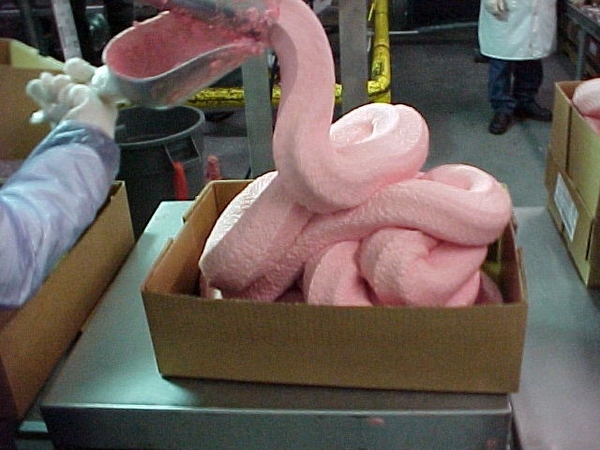
We were discussing the relative merits of the food at McDonald's yesterday in my Philosophy and Public Issues class. One student remarked that the food there tastes much better than that of our cafeteria at UPB. One of the topics that we'll address in my class is the moral implications of the food we eat, and we'll consider ways of eating more sustainably/morally. As an introduction to this topic, I thought I'd post an image of, well, I'm not sure what to call it-- chicken custard. It's what composes the bulk of various chicken products in fast-food restaurants.

A blog called Fooducate has a nice caption for this pic: "Someone figured out in the 1960s that meat processors can eek out a few more percent of profit from chickens, turkeys, pigs, and cows by scraping the bones 100% clean of meat. This is done by machines, not humans, by passing bones leftover after the initial cutting through a high pressure sieve. The paste you see in the picture above is the result."
Here's another description of the process:
"Basically, the chicken is smashed and pressed through a sieve—bones, eyes, guts, and all. There’s more: because it’s crawling with bacteria, it will be washed with ammonia, soaked in it, actually. Then, because it tastes gross, it will be reflavored artificially. Then, because it is weirdly pink, it will be dyed with artificial color."
Jamie Oliver is a famous chef that was recently in a television show/documentary aptly titled Food Revolution. Here's a great clip. And here is an apparent industry-produced clip of a chicken nugget production line (with fantastic music for your viewing-pleasure). It's worth checking out the comments below these clips. The vast majority of folks see nothing wrong with the process. What do you think about it?
I think a good question to ask is whether taste is all that we should be worried about when it comes to deciding what to eat. You'll likely suggest that other things like our health, cost, the effect that food production has on our environment, and the quality of the life of the organism being eaten are things that also matter. But how much do these other considerations matter? How heavily do you weigh these other factors? Do these things even cross your mind when you're thinking about what to have for dinner? Should they cross your mind?
UPDATE 2/1/12: You might be interested in this piece from Michael Pollan (author of many books including The Omnivore's Dilemma and The Botany of Desire). If you don't know what the "food movement" is, you really should check this out.
Thursday, January 19, 2012
Hedonism
Hedonism is the view that pleasure/happiness is the only intrinsic good. This means that the only thing that is good "in-and-of-itself" is pleasure/happiness. Other things might be instrumentally valuable--that is, valuable as instruments or tools to get other things. Examples of instrumentally valuable things include money and cars. Money is good for buying things that one wants and cars are good for traveling from one place to another. But they don't have intrinsic value. It's not as if money is good for its own sake. It's only good in order to acquire goods/services.
I'm curious what you think about Hedonism. Is there anything else that is intrinsically valuable besides pleasure/happiness?
It's worth mentioning that some things might be both intrinsically valuable and instrumentally valuable [e.g., one's health or the beauty of a piece of art (?)]. My intuitions about these examples aren't clear. Are there examples that you find puzzling? Perhaps a discussion of the puzzling cases will shed some light on the debate over whether Hedonism is true or false.
Tuesday, January 17, 2012
Discussion Group
Wednesday's topic for discussion will be: justice and wealth. You'll want to check out my previous post on this topic. Richard Wilkinson's TED talk is especially interesting. You'll also find a handful of comments from various readers of this blog. This topic should make for a lively discussion.
Again, we're meeting tomorrow (1/18) at 6:30 at the Aud.
Undergraduate Conference
There will be a conference in May at Western Michigan University having to do with bioethics. Those of you that have taken my Ethics, Bioethics, or Philosophy and Public Issues courses should consider submitting a paper. I'd be happy to help you it up before you submit it. Also, I suspect that you could get some funding via our Undergraduate Research Award to attend the conference. Let me know if you're interested in this and I'll help you complete all the forms.
Biomedical ethics papers should be 3000 words (about 20 minutes presentation time) and prepared for blind review (name and identifying information should appear nowhere on the paper). Attach your paper and separate cover page that contains name, address, phone number, e-mail address and school affiliation as a Word or PDF file to the e-mail. The e-mail subject line should read “Undergraduate Biomedical ethics Paper Submission”
Submission deadline March 1st, 2012
Accepted authors will be notified by March 15th. Papers not prepared for blind review will be rejected. We respectfully request that we receive submissions only from those who plan to attend the conference if accepted.
e-mail submissions to ugbioethicswmu@gmail.com
Undergraduate Biomedical Ethics Symposium
May 5, 2012
Hosted by University Center for the Humanities
2500 Knauss Hall
Hosted by University Center for the Humanities
2500 Knauss Hall
Biomedical ethics papers should be 3000 words (about 20 minutes presentation time) and prepared for blind review (name and identifying information should appear nowhere on the paper). Attach your paper and separate cover page that contains name, address, phone number, e-mail address and school affiliation as a Word or PDF file to the e-mail. The e-mail subject line should read “Undergraduate Biomedical ethics Paper Submission”
Submission deadline March 1st, 2012
Accepted authors will be notified by March 15th. Papers not prepared for blind review will be rejected. We respectfully request that we receive submissions only from those who plan to attend the conference if accepted.
e-mail submissions to ugbioethicswmu@gmail.com
Friday, January 13, 2012
Friday Paradox:
This one is from Bertrand Russell.
The Barber Paradox
A certain village has a barber named Saul. Saul is an affable fellow and is liked by everyone who knows him. But Saul has a peculiar practice from which he never waivers. He shaves all and only those adult male villagers who do not shave themselves. Now Saul is an adult male who lives in the village and he is clean-shaven. So an interesting question arises: Does he or does he not shave himself?
You might think that Saul does shave himself but this would contradict his practice of only shaving those individuals that do not shave themselves. Alternatively, you might think that Saul does not shave himself but this would contradict his practice of shaving all those individuals that do not shave themselves. Something has to give!?
* I should mention that Saul is a "normal" adult male and would have a beard if it were not for the fact that his face is regularly shaved.
(No cheating now... try to solve it on your own.)
Monday, January 9, 2012
Causes vs. Background Conditions
Consider a typical case of causation. Lucy strikes a match to light her grill. It's a beautiful sunny day and there's not a hint of wind. Not surprisingly, the match ignites and she is able to start her grill. I take it that it is the striking of the match that causes it to light.
But there are (what some might call) background conditions that are required for the match to light, like the presence of oxygen and a lack of rain and gusty winds. If the match were wet, then it wouldn't light. And if it were too windy, it wouldn't light. So here's an interesting question: Do the background conditions (also) cause the match to light? This might sound odd. We don't say things like "The striking of the match and the presence of oxygen caused the match to light."
Various theories of causation seem to entail that we should say that these background conditions count as causes (See, for example, David Lewis's view in his essay "Causation" and J.L. Mackie's view in his book The Cement of the Universe, among others). Some folks take the above to be a direct challenge to such theories while others bite the proverbial bullet and simply insist that such background conditions are indeed causes. What do you think about this?
If you think the background conditions are not causes, how exactly do you distinguish between the two and explain why these background conditions aren't causes?
If you think they are causes, then how do you explain our practice of not treating them as such? Why are so many people tempted to say that there's a metaphysical difference between causes and mere background conditions? How do you show that this is a mistake?
Friday, January 6, 2012
Friday Paradox:
I'll occasionally post a paradox or puzzling case on a Friday. Today's is an old one--4th century B.C. It's from Eubulides.
The Horn Paradox:
(1) You don't have horns.
(2) If you have not lost something, you still have it.
(3) You have not lost any horns.
(4) Therefore, you (still) have horns. (This follows from (2) and (3))
(5) But (4) contradicts (1) and so we're saddled with a paradox.
If you think you've got a solution to the paradox, please share it with the rest of us by making a comment to this post.
Subscribe to:
Posts (Atom)