Friday, January 27, 2012
Graduate School Workshop on 1/28
I'll be leading a workshop with Nicole Amrhein ('08 grad/currently an attorney) on applying to graduate school. This will take place tomorrow at 11:00 in Swarts 111. This is part of the annual "Backpack to Briefcase" event at UPB.

Friday Paradox:
Zeno put forward a number of paradoxes. The upshot of many of them is that motion is impossible. This is a pretty startling conclusion, but his reasons seem fairly plausible.
Suppose I want to go out to eat and I decide to walk to the restaurant. Let A be my house and B be the restaurant. In order for me to get from A to B, I must cover half the distance between them. So I must get to point C. But in order for me to get from A to C, I must cover half of that distance. So I must get to point D. But in order for me to get from A to D, I must cover half of that distance. So I must get to point E... you get the idea. The issue is that there are an infinite number of "halves" that I have to traverse and so I'll never be able to get the full distance. How can one ever traverse an infinite number of points? So I can never actually get to the restaurant. Of course, we can generalize this and so it looks like all movement is impossible. So, contrary to the way things appear, nothing is really moving!
This wonderful clip explains another of Zeno's paradoxes (sometimes called "Achilles and the Tortoise") quite well. It has quite a bit in common with the one I describe above and the visual representation of the issue might be helpful.
Now, of course, most of think motion is possible. So the trick is identifying where Zeno's argument went awry.
Good luck and enjoy the weekend!
Suppose I want to go out to eat and I decide to walk to the restaurant. Let A be my house and B be the restaurant. In order for me to get from A to B, I must cover half the distance between them. So I must get to point C. But in order for me to get from A to C, I must cover half of that distance. So I must get to point D. But in order for me to get from A to D, I must cover half of that distance. So I must get to point E... you get the idea. The issue is that there are an infinite number of "halves" that I have to traverse and so I'll never be able to get the full distance. How can one ever traverse an infinite number of points? So I can never actually get to the restaurant. Of course, we can generalize this and so it looks like all movement is impossible. So, contrary to the way things appear, nothing is really moving!
This wonderful clip explains another of Zeno's paradoxes (sometimes called "Achilles and the Tortoise") quite well. It has quite a bit in common with the one I describe above and the visual representation of the issue might be helpful.
Now, of course, most of think motion is possible. So the trick is identifying where Zeno's argument went awry.
Good luck and enjoy the weekend!
David Lewis, the Philosophical Conservative
Steve Pyke is a photographer that took a number of philosophers' pictures. He asked many of them to provide a few sentences about their approach to philosophy. David Lewis was one of them. He remarked:
"I am philosophically conservative: I think philosophy cannot credibly challenge either the positive convictions of common sense or the established theses of the natural sciences and mathematics."
In a famous book of his called Counterfactuals, Lewis writes:
"I believe, and so do you, that things could have been different in countless ways. But what does this mean? Ordinary language permits the paraphrase: there are many ways things could have been besides the way they actually are. I believe that things could have been different in countless ways; I believe permissible paraphrases of what I believe; taking the paraphrase at its face value, I therefore believe in the existence of entities that might be called ‘ways things could have been.’ I prefer to call them ‘possible worlds’" (page 84).
We discussed Lewis' ideas about possibility in my Metaphysics and Epistemology class. His view was that possible worlds are real and that they're just as real as the actual world. Here and here are more information about this view (now called modal realism).
Is Lewis' view philosophically conservative? Does he depart from the "positive convictions of common sense"? It doesn't seem conservative/like common sense to me. Of course, this doesn't show that his view is false. It's just not something that someone like my mother would propose as an explanation of possibility.
We only briefly touched on this in class, but a possible paper topic can be found here. I wonder what your thoughts are regarding modal realism and whether you think some alternative theory about possibility is more plausible. (This would likely have to be the long paper due at the end of the term, since it requires so much stage-setting and exposition.)
Here's one of the pictures that Pyke took of Lewis:

"I am philosophically conservative: I think philosophy cannot credibly challenge either the positive convictions of common sense or the established theses of the natural sciences and mathematics."
In a famous book of his called Counterfactuals, Lewis writes:
"I believe, and so do you, that things could have been different in countless ways. But what does this mean? Ordinary language permits the paraphrase: there are many ways things could have been besides the way they actually are. I believe that things could have been different in countless ways; I believe permissible paraphrases of what I believe; taking the paraphrase at its face value, I therefore believe in the existence of entities that might be called ‘ways things could have been.’ I prefer to call them ‘possible worlds’" (page 84).
We discussed Lewis' ideas about possibility in my Metaphysics and Epistemology class. His view was that possible worlds are real and that they're just as real as the actual world. Here and here are more information about this view (now called modal realism).
Is Lewis' view philosophically conservative? Does he depart from the "positive convictions of common sense"? It doesn't seem conservative/like common sense to me. Of course, this doesn't show that his view is false. It's just not something that someone like my mother would propose as an explanation of possibility.
We only briefly touched on this in class, but a possible paper topic can be found here. I wonder what your thoughts are regarding modal realism and whether you think some alternative theory about possibility is more plausible. (This would likely have to be the long paper due at the end of the term, since it requires so much stage-setting and exposition.)
Here's one of the pictures that Pyke took of Lewis:

Thursday, January 26, 2012
Did Socrates' death cause his wife to be a widow?
I'm teaching a class celled Metaphysics and Epistemology this semester. One of the books for the class is by John Carroll and Ned Markosian and it's entitled An Introduction to Metaphysics. A number of students found the example of the passage below perplexing (this appears on page 29):
"When Socrates drank the hemlock and died in the Athenian prison, his wife, Xanthippe, became a widow. Did Socrates' death cause Xanthippe to become a widow?... Many philosophers find this conclusion unacceptable. The worry is that any relation holding between these two events is bound not to be of the tangible/physical sort one normally expects causation to be. The connection seems to be too much a conceptual matter. To drive home this point, sometimes it is argued that, since Xanthippe was not in the prison with Socrates, his death could not have caused her to become a widow. She became a widow the instant he died. Since there is no instantaneous causal action at a distance in a world like ours where no signals travel faster than light, his death didn't cause her widowhood."
If I were taking the class, I'd be tempted to write one of my papers on something related to this example. There are some fascinating questions that are raised in this short passage. Can there be instantaneous causation at a distance? Does causation require a "tangible/physical" bond between two events? If she became a widow the instant he died, then what (if not his death) caused this effect?
I'm hoping readers will make some suggest some answers to these questions and shed some light on these issues.
"When Socrates drank the hemlock and died in the Athenian prison, his wife, Xanthippe, became a widow. Did Socrates' death cause Xanthippe to become a widow?... Many philosophers find this conclusion unacceptable. The worry is that any relation holding between these two events is bound not to be of the tangible/physical sort one normally expects causation to be. The connection seems to be too much a conceptual matter. To drive home this point, sometimes it is argued that, since Xanthippe was not in the prison with Socrates, his death could not have caused her to become a widow. She became a widow the instant he died. Since there is no instantaneous causal action at a distance in a world like ours where no signals travel faster than light, his death didn't cause her widowhood."
If I were taking the class, I'd be tempted to write one of my papers on something related to this example. There are some fascinating questions that are raised in this short passage. Can there be instantaneous causation at a distance? Does causation require a "tangible/physical" bond between two events? If she became a widow the instant he died, then what (if not his death) caused this effect?
I'm hoping readers will make some suggest some answers to these questions and shed some light on these issues.
Enlightened Brazilians
Brazil has required high school students to take philosophy courses since 2008 because it is "necessary for the exercise of citizenship." Here's a recent article from a Boston newspaper on the program.
What I find especially interesting about the article is the discussion toward the end about perceptions of justice.
(Thanks to Brian Leiter for posting the link on his blog.)
What I find especially interesting about the article is the discussion toward the end about perceptions of justice.
(Thanks to Brian Leiter for posting the link on his blog.)
Wednesday, January 25, 2012
State of the Union
Obama gave his State of the Union address last night and a main thrust of his speech was an issue addressed in a previous post on this blog having to do with economic inequality and justice. He made a variety of comments directed at giving each person a "fair shot" and he insisted that everyone must play by the "same rules." Regardless of one's political leanings, I think it's hard to reject a call for fairness. One might wonder, however, what particular policies are in order to assure such fairness. Obama did offer some particular examples of such policies. These related to tax reform, rules related to politicians owning stock in certain companies, campaign finance reform, etc. I wonder what you think about his suggestions. Also what (other) policy changes do you think are in order?
The difference in coverage of his address is worth noting. Compare, for example, this and this.
[Obama also had a bit to say about energy policy. I plan on writing a post on this topic next month when I cover energy in my Philosophy and Public Issues course. So keep an eye out for that.]
The difference in coverage of his address is worth noting. Compare, for example, this and this.
[Obama also had a bit to say about energy policy. I plan on writing a post on this topic next month when I cover energy in my Philosophy and Public Issues course. So keep an eye out for that.]
Friday, January 20, 2012
Friday Paradox:
We often say that certain things don't exist. Santa, unicorns, Sherlock Holmes, and Atlantis are a few examples. But consider the sentence "Unicorns do not exist." This sentence seems to have a subject-predicate form in that there is a subject--unicorns--to which a predicate or property--non-existence--is being attributed. Consider other subject-predicate sentences: Sarah is tall. John doesn't like mushrooms. Liza does not have a car. By saying that these various people have these various properties, we are implying that these people exist. But aren't we then doing the same thing when we say of unicorns that they do not exist. Aren't we saying that unicorns have a certain property; namely, the property of non-existence? If so, then what are we talking about that have this property but unicorns? There has to be a subject of the sentence. Here's another way to put this: To be able to truly claim of an object that it doesn't exist, it seems that one has to presuppose that it exists, for doesn't a thing have to exist if we are to make a true claim about it?
Mechanically Separated Meat--Yum
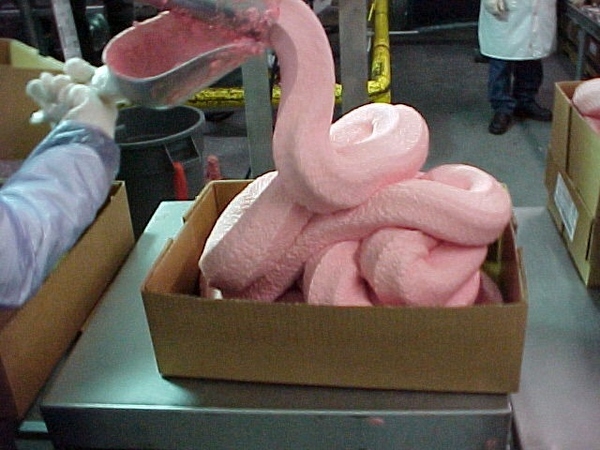
We were discussing the relative merits of the food at McDonald's yesterday in my Philosophy and Public Issues class. One student remarked that the food there tastes much better than that of our cafeteria at UPB. One of the topics that we'll address in my class is the moral implications of the food we eat, and we'll consider ways of eating more sustainably/morally. As an introduction to this topic, I thought I'd post an image of, well, I'm not sure what to call it-- chicken custard. It's what composes the bulk of various chicken products in fast-food restaurants.

A blog called Fooducate has a nice caption for this pic: "Someone figured out in the 1960s that meat processors can eek out a few more percent of profit from chickens, turkeys, pigs, and cows by scraping the bones 100% clean of meat. This is done by machines, not humans, by passing bones leftover after the initial cutting through a high pressure sieve. The paste you see in the picture above is the result."
Here's another description of the process:
"Basically, the chicken is smashed and pressed through a sieve—bones, eyes, guts, and all. There’s more: because it’s crawling with bacteria, it will be washed with ammonia, soaked in it, actually. Then, because it tastes gross, it will be reflavored artificially. Then, because it is weirdly pink, it will be dyed with artificial color."
Jamie Oliver is a famous chef that was recently in a television show/documentary aptly titled Food Revolution. Here's a great clip. And here is an apparent industry-produced clip of a chicken nugget production line (with fantastic music for your viewing-pleasure). It's worth checking out the comments below these clips. The vast majority of folks see nothing wrong with the process. What do you think about it?
I think a good question to ask is whether taste is all that we should be worried about when it comes to deciding what to eat. You'll likely suggest that other things like our health, cost, the effect that food production has on our environment, and the quality of the life of the organism being eaten are things that also matter. But how much do these other considerations matter? How heavily do you weigh these other factors? Do these things even cross your mind when you're thinking about what to have for dinner? Should they cross your mind?
UPDATE 2/1/12: You might be interested in this piece from Michael Pollan (author of many books including The Omnivore's Dilemma and The Botany of Desire). If you don't know what the "food movement" is, you really should check this out.

A blog called Fooducate has a nice caption for this pic: "Someone figured out in the 1960s that meat processors can eek out a few more percent of profit from chickens, turkeys, pigs, and cows by scraping the bones 100% clean of meat. This is done by machines, not humans, by passing bones leftover after the initial cutting through a high pressure sieve. The paste you see in the picture above is the result."
Here's another description of the process:
"Basically, the chicken is smashed and pressed through a sieve—bones, eyes, guts, and all. There’s more: because it’s crawling with bacteria, it will be washed with ammonia, soaked in it, actually. Then, because it tastes gross, it will be reflavored artificially. Then, because it is weirdly pink, it will be dyed with artificial color."
Jamie Oliver is a famous chef that was recently in a television show/documentary aptly titled Food Revolution. Here's a great clip. And here is an apparent industry-produced clip of a chicken nugget production line (with fantastic music for your viewing-pleasure). It's worth checking out the comments below these clips. The vast majority of folks see nothing wrong with the process. What do you think about it?
I think a good question to ask is whether taste is all that we should be worried about when it comes to deciding what to eat. You'll likely suggest that other things like our health, cost, the effect that food production has on our environment, and the quality of the life of the organism being eaten are things that also matter. But how much do these other considerations matter? How heavily do you weigh these other factors? Do these things even cross your mind when you're thinking about what to have for dinner? Should they cross your mind?
UPDATE 2/1/12: You might be interested in this piece from Michael Pollan (author of many books including The Omnivore's Dilemma and The Botany of Desire). If you don't know what the "food movement" is, you really should check this out.
Thursday, January 19, 2012
Hedonism
Hedonism is the view that pleasure/happiness is the only intrinsic good. This means that the only thing that is good "in-and-of-itself" is pleasure/happiness. Other things might be instrumentally valuable--that is, valuable as instruments or tools to get other things. Examples of instrumentally valuable things include money and cars. Money is good for buying things that one wants and cars are good for traveling from one place to another. But they don't have intrinsic value. It's not as if money is good for its own sake. It's only good in order to acquire goods/services.
I'm curious what you think about Hedonism. Is there anything else that is intrinsically valuable besides pleasure/happiness?
It's worth mentioning that some things might be both intrinsically valuable and instrumentally valuable [e.g., one's health or the beauty of a piece of art (?)]. My intuitions about these examples aren't clear. Are there examples that you find puzzling? Perhaps a discussion of the puzzling cases will shed some light on the debate over whether Hedonism is true or false.
I'm curious what you think about Hedonism. Is there anything else that is intrinsically valuable besides pleasure/happiness?
It's worth mentioning that some things might be both intrinsically valuable and instrumentally valuable [e.g., one's health or the beauty of a piece of art (?)]. My intuitions about these examples aren't clear. Are there examples that you find puzzling? Perhaps a discussion of the puzzling cases will shed some light on the debate over whether Hedonism is true or false.
Subscribe to:
Posts (Atom)